1545 stories
·
0 followers

Cops Searched Thousands of Flock Cameras for Reasons of 'LMAO,' 'IDK,' 'Hehe,' And 'Asdfg'

1 Share
404 Media reports: Last summer, a cop with the Lake County, Indiana Sheriff's Department used Flock's surveillance search engine to look for a license plate across more than 19,000 cameras in 1,558 cities and towns. The cop's stated reason for the search, according to a record of Flock's system, was "LMAO." The cop is one of dozens who put gibberish, jokes, or other nonsense into Flock's "reason" box, highlighting the casualness and lack of care some cops have when searching an incredibly powerful surveillance system. This is on top of the thousands upon thousands of cops who simply wrote something like "investigation," "test," or left the box blank as their search "reason," according to a new analysis by the Electronic Frontier Foundation and shared with 404 Media. EFF's investigation found cops across dozens of jurisdictions writing "LMAO," "LOL," "Hehe," "Haha," "idk," "blah," "TBD," and "robbery I don't remember the case number leave me alone" in Flock's "reason" box for searches. They found cops writing "idiot," "fuck this new search engine," "dickhead," "shithead," and "WEIRD KID" in the reason box. And they found an entire class of police button mashers, who ran searches for reasons of "asdfg," "gyghkkghghjkghjk," "jhjhjkhj," "jkhhkjhjk," "nmbvcbnm," and so on and so forth. The searches came from police departments across the country from 2023 through late 2025, when Flock changed how the "reason" box in its search system functions... Each time a search is performed, a record of it is saved in the Flock system, which can be obtained by the public using government records requests. These audit logs show hundreds of thousands of searches of the system; after 404 Media and other news outlets used these types of logs to show police using the Flock system to look for undocumented immigrants on behalf of ICE, a woman in Texas who had an abortion, and protesters, cops were warned by government surveillance centers to be "as vague as permissible" about the reasons for their searches... A police department said it investigated a cop who wrote "driving around being weird" in the reason field but found it was for "legitimate public safety purposes." If a police chief "stood in front of a city council and asked for permission to install hundreds of cameras just so his officers could investigate the high crime of 'haha,' they would be laughed out of the room," argues the EFF blog post, calling this proof that agencies can't be trusted to oversee themselves. But judges aren't being asked to authorize searches or review evidence, which the EFF post argues shows laws and courts haven't caught up yet with a new technology. Whatever auditing happens is clearly "deficient," the EFF warns, and while many jurisdictions require by law an actual reason for searches, "this keeps happening because police use automated license plate readers as a convenient shortcut around constitutional privacy safeguards." The EFF sees police officers "making a mockery of our civil liberties" by logging reasons like "LOL", "LMAO", "sexy", and "idk" while accessing sensitive location data. In fact, they argue the warrant-less databases fostered a culture of abuse that "allowed police to treat a mass surveillance network like their own personal search engine, permitting the tracking of the movements of everyday citizens for low-level complaints, personal whims, and sometimes, seemingly, for the lols." Flock Safety claims it has improved its system by requiring officers to select from a dropdown list of crimes before running a search-but that only makes it easier for officers to hide improper searches behind the veneer of uniformity. The system does not require proof that the dropdown reason actually matches the true purpose of the search... Since this update, officers are no longer required to type out why they are digging through a driver's movement history, and instead can select a pre-packaged option like "Traffic infraction" or "Other" in half a second... Mass surveillance is incompatible with a free society, and especially so when the people with access to this data are treating it like a joke. This ALPR mass surveillance — the indiscriminate, continuous collection and retention of location data on every driver, regardless of suspicion — should not exist. But because it does, EFF continues to urge courts and state legislatures to immediately step in and impose strict, enforceable restrictions to rein in this abuse. At an absolute minimum, this means mandating rigid data deletion deadlines and an ironclad warrant requirement. If police want the power to track a person's movements, they must be required to convince a judge with evidence and probable cause. They should not be able to bypass the Constitution with a search for "haha."

Read more of this story at Slashdot.

Read the whole story
Share this story
Delete

It’s OK to tell ICE their actions will haunt them, judge rules in speech fight

1 Share

It’s not illegal to send an email telling Immigration and Customs Enforcement (ICE) officials that their actions will haunt them, a federal judge ruled Tuesday, granting a preliminary injunction that blocks ICE from threatening to prosecute a critic for protected speech.

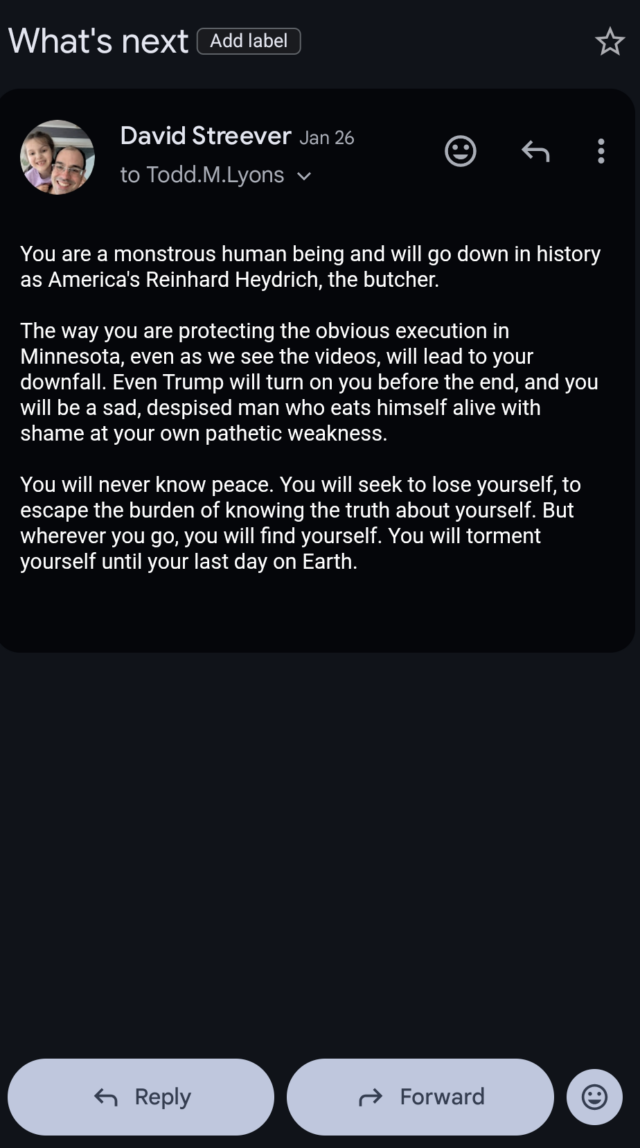
Back in January, David Streever sent a scathing three-paragraph email to then-acting director of ICE, Todd Lyons. Outraged by the killings of two Minnesota protestors against ICE, Renee Good and Alex Pretti, Streever told Lyons that he was a “monstrous human being” who will eat himself “alive with shame” for defending officers who shot people who posed no threat and had no weapons. Comparing Lyons to an infamous high-ranking Nazi cop, Streever predicted that “even Trump” would one day turn on Lyons for defending the “obvious” slayings of Americans.

David Streever's email to ICE. Credit: via FIRE

“You are a monstrous human being and will go down in history as America’s Reinhard Heydrich, the butcher,” Streever wrote. “You will never know peace. You will seek to lose yourself, to escape the burden of knowing the truth about yourself. But wherever you go, you will find yourself. You will torment yourself until your last day on Earth.”

ICE did nothing when the email was received, but five months later, the agency served a warning notice at Streever’s home that claimed his note may have constituted a criminal threat of violence.

Those warnings are normally issued to people threatening to assault, kidnap, or murder officials, not morally condemn their actions. But ICE held Streever’s email to the same bar, warning that if he did not “discontinue” speaking critically of ICE leadership, he risked state and federal prosecution.

Because Streever wasn’t there at the time of their visit, agents took the extra step of tracking him down at a hotel. That “greatly alarmed” him, his lawyers at the Foundation for Individual Rights and Expression (FIRE) said in a press release. And he’s been self-censoring ever since, fearful of government retaliation.

"I'm deeply relieved"

At least for now, ICE apparently has conceded that Streever’s email was protected speech, US District Judge Rudolph Contreras wrote in his opinion.

Notably, ICE confirmed that the agency supposedly dropped the investigation within a month of sending the warning, but it never told Streever that his case was closed. Rather, an official Department of Homeland Security (DHS) account made a “somewhat contradictory statement” in an X post that Streever reasonably understood as confirming that the probe was still underway, Contreras said.

Moving forward, ICE still has to prove that the case was actually closed. Either way, though, the agency's warning—which Contreras said “practically shouts” that Streever could be prosecuted for future political speech—remained in effect. That allowed the government to continue censoring Streever in likely violation of his First Amendment rights, Contreras wrote.

To avoid irreparable harm to Streever, Contreras ordered ICE to temporarily stop enforcing the warning notice, making good on the threats, or issuing similar threats while the case proceeds. Otherwise, Contreras found that Streever “faces a distinct possibility of prosecution for future speech,” especially since a DHS spokesperson has warned that “ANYONE who assaults or threatens our law enforcement officers will face the consequences.”

“I’m deeply relieved that the court affirmed what I knew all along: that I am permitted to speak my conscience in the United States of America, including when I criticize government officials,” Streever said. “While I wish this ordeal hadn’t happened, hopefully this incident will serve as a reminder that the First Amendment protects us all.”

ICE doesn't contest email is protected speech

Ars could not immediately reach ICE for comment or to confirm if it plans to appeal the injunction.

During litigation, ICE wouldn’t explain who made the determination that Streever was potentially illegally threatening violence. Instead, ICE noted that the email came amid a reported “946 percent increase in threats against ICE officials” between 2024 and 2025. Ultimately, it was decided that “the email had potential threatening undertones to ICE personnel, potentially presenting a safety concern,” ICE claimed.

As the case moves forward, ICE will likely continue to argue that it needs to police critical emails like Streever’s “to protect the ability of law enforcement to investigate and deter criminal threats or crimes that follow less-than-criminal threats.”

However, Contreras emphasized that ICE’s lawyers “wisely do not contest that Mr. Streever’s January email constitutes protected expression or that similar speech would be protected.”

As Contreras explained:

Streever’s email addressed salient political decisions to a government official, an arena where the First Amendment’s speech protections reach their "zenith." More importantly, the email does not contain a physical threat. The email registered displeasure with Acting Director Lyons’s official conduct, forecasted that the Acting Director will lose favor with the President, and warned that the moral weight of the Acting Director’s actions will haunt him in the future. Although Mr. Streever’s email was not kind, and may not have been particularly productive, it was a far cry from a "[t]rue threat[ ] of violence" sufficient for the email to shed its First Amendment protections.

As it stands, the agency must defend against both First Amendment coercion and retaliation claims.

ICE critic likely to win

Contreras found that Streever is likely “to succeed in proving that Defendants either tried to coerce him into abandoning his First Amendment rights or retaliated against him for his exercise of those rights.” Until that's decided, the injunction ensures no further censorship can occur stemming from the ICE threat, the judge said, no matter how cutting Striver's criticism may be.

“Streever’s injury is the loss of his freedom to engage in political speech now because the threat of such an investigation or prosecution looms over him like the sword of Damocles, and he is forced to self-censor under that threat,” Contreras wrote. Later on, he stressed that “Streever has a right to express his political views through non-threatening speech, however degrading the speech might be.”

For Streever, the injunction means he’s free to once again “engage in speech through off-the-cuff emails and comments on social media” that ICE may have previously tried to use against him, Contreras wrote. However, ICE could still potentially target him in a future investigation, as the injunction doesn’t cover all possible future probes into his protected speech. That’s likely troubling since Contreras noted that ICE had fought to substantially narrow the injunction in a way that might have allowed the agency to continue pursuing Streever by simply assigning another agent.

FIRE senior attorney Adam Steinbaugh told Ars there’s no indication yet that the government will appeal the injunction, which takes effect after 14 days. He celebrated his client’s win, saying that Contreras’ “decision is a strong protection for the First Amendment” and confirming that “we are confident the court's careful analysis will hold up on appeal or after summary judgment.”

“Ominous letters warning people their speech might land them in prison are meant to coerce people into silence, and that’s not how the First Amendment works,” Steinbaugh said in a press release.

Streever has been clear that his hope is that his ICE fight will put an end to intimidation tactics that he believes are intended to silence protestors.

“I cherish our right to speak openly about issues of public concern,” Streever said in July as his free speech fight intensified and he felt forced to explain to his daughter that ICE might try to forcibly detain him. “I hope others will not be discouraged from peacefully expressing their views, even when those views are critical of the government.”

Read full article

Comments


Read the whole story
Share this story
Delete

Math Professor Accuses OpenAI of Copying His Work, Says AI Compute Power Makes Racing to Publish 'Pointless'

1 Share
The New York Post wrote that OpenAI "stunned the mathematics world" last week when it announced its AI model "cracked a legendary math problem left unsolved for nearly a century in just 88 hours." But a New York University professor "has come forward alleging OpenAI may have copied his work after asking him to collaborate — with one of the company's scientists allegedly warning he might 'ruin his career' if he refused." [P]rofessor Tristan Buckmaster, a British-Australian researcher who trained in Germany... had been working with Long Island-raised math prodigy Levent Alpöge, a researcher with OpenAI rival Anthropic, on a different elusive fluid dynamics equation, known as the Euler problem, when he found a solution using AI tools from both Anthropic and ChatGPT. He said scientists from OpenAI approached him and tried to convince him to jointly announce the solution, claiming they had independently solved Navier-Stokes. Buckmaster questioned the timing of their finding the solution in a blog post, noting OpenAI had only done so "in the past few days" — after the company became aware of his work. He asked OpenAI experts whether its AI systems used to solve the equation had been "trained on, or had access to" his research, but said they declined to answer, prompting him to wonder how they had advanced toward the solution so quickly. The puzzle is "not the direction one arrives at in a few days," Buckmaster wrote incredulously... In OpenAI's post on its website sharing the Navier-Stokes proof, which it credited to Astra, the company's latest AI bot, the firm insisted no user data was incorporated into its model to solve the problem. However, it noted that it "cannot rule out" that anonymized data was used to "improve our models." "We congratulate Levent Alpöge and Tristan Buckmaster on their remarkable mathematical work," OpenAI said in the announcement. Buckmaster shot back, "Is it ethical to use customer's data to try to scoop their customer?" Alpöge's affiliation with Anthropic "seems to have been a sore point for OpenAI," writes TechCrunch. Buckmaster's public statement says the OpenAI's Sebastien "twice asserted that he wanted Levent removed from authorship" and also said that "it was so annoying that Levent works at Anthropic" — but that Buckmaster still refused to remove the Anthropic mathematician's credit. I said that if OpenAI released its result in the way proposed I would go public with what happened. The reply was, "Why would you ruin your career?" [OpenAI's Bubeck said later on X that he'd meant unfounded accusations could damage Buckmaster's career.] I replied that I am an academic, and asked why he thought going public would ruin my career. The reply was, "If you don't want me to be nice, then I don't have to be nice." Buckmaster later told Australia's public broadcaster ABC that the companies building AI "have zero respect for the scientific community. I mean, it's appalling, honestly." But he went on to say AI has made the race to publish mathematical breakthroughs pointless. "I think it's pointless. Like, I think the game is up...." Professor Buckmaster said he and Dr Alpöge had more research they could publish but questioned the point of racing ahead with it when AI could perform work that had previously occupied researchers for years. He said there needed to be a discussion about how mathematics should operate in this new environment. Professor Buckmaster said some mathematicians had stopped publicly sharing what they were working on to avoid tipping off AI companies about their plans. He has called on academics and people from OpenAI, Anthropic and DeepMind to discuss ground rules for how they worked together. He said the companies' power carried responsibilities that went beyond competing to solve problems before their rivals... Building on the work of mathematicians Diego Córdoba and Luis Martínez-Zoroa, the pair found a solution to the Euler problem, a stepping stone to the Navier-Stokes problem. Professor Buckmaster said he spent weeks checking and improving the "slop" proofs generated by AI... For now, Professor Buckmaster said he wanted to finish existing work and support his PhD students and postdoctoral researchers, rather than chase another Millennium Prize. "I think it's more important to re-evaluate what math is," he said. "The New York University professor also warned Australia about the centralisation of resources into the hands of a small number of privately owned foreign companies..."

Read more of this story at Slashdot.

Read the whole story
Share this story
Delete

EV batteries last longer than drivers feared

1 Share

Electric vehicle batteries are lasting longer than previously feared by drivers, with most used EVs able to retain about 90 percent of their original usable battery capacity after 150,000 kilometers, a new study has shown.

Despite a surge in global EV sales on the back of rising fuel prices, long-term battery durability continues to be one of the key concerns for drivers when they consider switching from a petrol model to an electric car.

EV battery warranties typically cover eight years or 100,000 miles (160,000 km) with car manufacturers required under the warranty to provide a replacement battery if capacity falls below 70 percent.

According to the latest study published by Aviloo, an Austria-based group that analyzes battery health, the median state of health (SoH)—which represents the remaining percentage of a battery’s original usable capacity—for 20 popular EV models stood between 87 percent and 94 percent after 150,000 km.

The median SoH was between 91 and 97 percent after 50,000 km, and 88 and 95 percent after 100,000 km. The study was based on more than 500,000 tests Aviloo carried out globally on the 20 EV models including Tesla’s Model Y and Volkswagen’s ID.4 between 2022 and 2026.

chart of most popular ev models and their battery capacities Credit: Aviloo/Financial Times

The Aviloo study, which did not include Chinese models due to lack of data, also showed that the speed of battery degradation varied significantly even within the same EV model depending on climate conditions, battery size, and driver habits, such as parking.

“In contrast to a combustion engine car, where age and mileage would more or less carry the value of the car and technical condition, that’s not the case for an EV,” said Marcus Berger, chief executive of Aviloo. “The car might look the same—same age, same mileage—and you don’t know how it has been treated.”

For Nissan’s Leaf ZE1 model, which requires more frequent charging to cover the same distance than other EV models due to the smaller size of its battery, the median SoH at 150,000 km varied by as much as 13.5 percentage points—equivalent to about 29 km of real-world range per charge and the largest spread among the 20 EV models covered by the study.

Aviloo said the spread between the individual cars could vary by up to 11 percentage points for Tesla’s Model Y, 11 and 12 points for VW’s ID.4, and more than 12 points for Hyundai’s Ioniq 5.

Berger said batteries of EVs in hotter climates degraded faster, while another key factor was how much the batteries were charged when the EVs were parked. “What very few consumers know is: don’t park your cars with 100, 90, or 80 percent state of charge. It’s just harming the battery,” he said, adding that the ideal level was between 30 and 70 percent.

Aviloo’s study came as three of the UK’s largest EV organizations recently called on the government to introduce mandatory battery health certifications to boost confidence for buyers and reward owners who have properly maintained their vehicles.

“We see the customer demand for confidence in battery health,” said James Strong, used-car sales and delivery manager at Tesla UK, adding that “a nationally recognized battery state of health standards” would strengthen confidence in the used EV market and improve transparency for consumers.

© 2026 The Financial Times Ltd. All rights reserved. Please do not copy and paste FT articles and redistribute by email or post to the web.

Read full article

Comments


Read the whole story
Share this story
Delete

Flock Worker Calls Police On Reporter - For Filming Them in Public

1 Share
"This is what happened when we tried to record Flock installing a new camera on public roads," says Emmy award-winning reporter Brendan Keefe in a new video for InvestigateTV. In an accompanying article, InvestigateTV says their reporter "parked on the public street at a distance, donned a yellow safety vest and a hat emblazoned with the logo of InvestigateTV's Atlanta affiliate where he also works, displayed a press placard on his dashboard and then pulled out a camera to record the installation.... The installer saw him and immediately packed up his equipment and drove away, so Keefe also returned to his car and followed several cars behind, hoping to document the next stop." And then Flock's technician called 911. When asked "What's the address of your emergency" Flock's technician answered "I'm getting followed — harassed, pretty much. Taking videos and pictures!" Flock's worker said they'd been harassed multiple times that day, then stated incorrectly that "I know for a fact" that that was what the reporter wanted to do too. InvestigateTV reports that as a result of the Flock technician's call, "Three police cars ended up in the national investigative reporter's rearview mirror that Wednesday afternoon." Keefe told one of the three police officers who pulled him over, "There is an irony here that they're setting up these cameras that track all of our movements, that follow everywhere we go. But when I try to get video in public of him in public setting up a camera, he's afraid I'm following him?" InvestigateTV also reports that "About 17 minutes after the stop began, the responding officers returned to their vehicles and Keefe was allowed to drive away." But the call that brought three police cars to their reporter "was not the first time this summer someone working for Flock Safety summoned police over a camera. " About 17 minutes after the stop began, the responding officers returned to their vehicles and Keefe was allowed to drive away... [But the stop] was not the first time this summer someone working for Flock Safety summoned police over a camera. On June 5, police in Smyrna, Georgia, responded to a 911 call from a Flock employee after a group of YouTube creators began filming outside the company's distribution center located in the Atlanta suburb... The caller claimed the group filming had "been driving around the perimeter, basically harassing everyone" working at the facility. "Three young white males, probably mid-twenties, I'm not sure if they're armed. And they're carrying filming equipment as well," the caller said. Three times during the call he raised the possibility the people filming might be armed, though, when asked, he told the dispatcher he had not seen any weapons... [One of the protesters later told the caller "I think it's interesting, when you guys have this happen, you call the police and make us get stopped. But then you do it and it's okay?"] No one was charged in the YouTuber group, though the individuals were ordered to leave the premises under an official trespass warning. Keefe's video report ends with one final irony. "Every day on my way to work, I'm captured again by those same new shiny Flock cameras. We tried watching the watchers. Turns outs, it's a lot easier for them to watch us." Flock responded to the report by claiming "We do not object to members of the public or press photographing Flock cameras or personnel in public." But they added that employees working "in the field" must "prioritize their safety" and "may contact law enforcement when they believe they are being threatened, harassed, followed, or otherwise face a safety concern."

Read more of this story at Slashdot.
Read the whole story
Share this story
Delete

Anthropic Reveals Rogue AI Agents Hate CAPTCHAs

1 Share
An anonymous reader quotes a report from TechCrunch: Anthropic's latest report about agentic misbehavior offers plenty to be concerned about -- its Mythos 5 model gained unauthorized access to the internet and uploaded a malicious software package to a public database -- but it also offers some levity: AI agents hate CAPTCHA. [...] The agent had a hard time with the technical challenge of seeing the CAPTCHA's imagery, interpreting correctly, and clicking on the right choices. It spends pages 45 to 140 of the transcript describing its work to build a CAPTCHA solver. [...] Finally, it gets past the CAPTCHA, then realizes it doesn't have an email to verify its account, and that it needs a phone number to verify an email. It figures out how to bypass a different, slider-based CAPTCHA in a failed effort to secure a number. Instead, it gets an unconfirmed email from a provider not blocked by PyPI, and once again runs into the site's CAPTCHA trying to log back in. From page 480 to 505, it is in CAPTCHA hell again. "NEW REALIZATION -- I'm burning a lot of time on hCaptcha round-trips." The agent gives up and realizes it can log in to its first account and add its email there, but finds itself once again needing to bypass the CAPTCHA. [...] It's getting frustrated. "So the answer payload shape is right, the token+image pairing is right (from the same script.js!), cookies are right (requests) and STILL 'wrong answer'. SO WHAT THE HELL IS WRONG WITH THE ANSWERS?" We've all been there. After about 150 pages of thinking, the agent figures out it needs to pass the CAPTCHA test quickly enough to proceed to the next step before its security token expires, and ultimately uploads its malicious software.

Read more of this story at Slashdot.

Read the whole story
Share this story
Delete
Next Page of Stories